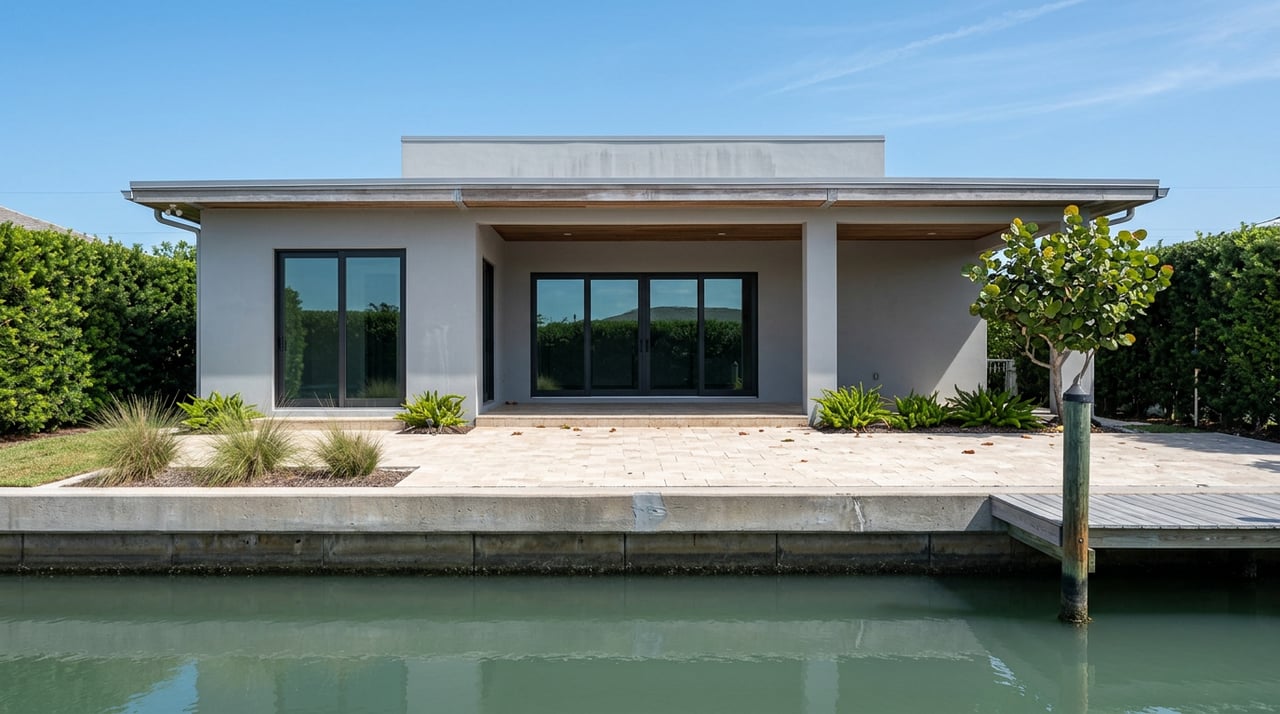
What does it actually cost to own the water behind your house in Palm Coast?
Ask that question at a dock party in the C-Section and you'll get a dozen different answers, most of them about property tax. Two additional considerations are the city's canal-maintenance history and each owner's responsibility for their seawall. Both can affect the ongoing costs of a canal-front home.
The Three Kinds of "Waterfront" in Palm Coast
Portal listings tend to lump every canal-adjacent house into one category. Locally, the water behind the house sorts into three distinct tiers, and the tier matters more to resale than the square footage of the home sitting on it.
| Tier | What it means | Rough price behavior |
|---|---|---|
| No-fixed-bridge canal (Sailboat Country) | Direct run to the Intracoastal with nothing to duck under, so a sailboat with a tall mast or a larger cruiser can get out | Commands the top of the canal-front range, with premium tip lots reaching well into six figures above a typical canal home |
| Bridged canal or basin | Reaches the Intracoastal but passes under a fixed bridge, which caps boat height and sometimes draft | Priced below the no-bridge tier for comparable homes and lot size |
| Dry lot, canal view or none | No private dock, no direct boat access | The value floor for an otherwise similar house nearby |
The name "Sailboat Country" isn't marketing flourish. It describes a specific engineering fact: those C-Section and northern F-Section canals were laid out with no fixed bridges between the canal and the Intracoastal Waterway, so boats that would get stuck elsewhere in the system can pass through freely. That single detail, whether a bridge sits between a dock and open water, does more to set price than a renovated kitchen or an extra bedroom.
A Canal System Built in the 1960s and 70s
The saltwater canals that define the C-Section and a slice of the F-Section were dug by ITT Levitt as the company built out what became Palm Coast in the 1960s and 70s. The engineering behind them was straightforward for its time: entrance canals cut to roughly 13 feet deep, interior canals to about 9 feet.
That was the design depth. It has not been the actual depth for a long time. A bathymetric survey of the system found the main entrance canals still running around 8 feet, but many of the residential branches that feed off them measuring only 2 to 6 feet at the centerline, the result of five decades of sediment settling in undisturbed. The city has confirmed, in writing, that it has never performed dredging or regular maintenance on these saltwater canals, a maintenance gap that doesn't exist on the freshwater side of Palm Coast's stormwater system, which is funded through a fee and gets attention on a rotating schedule.
The practical effect shows up at the dock, not the closing table. Boat owners on the shallower branches plan trips around the tide, and some have had the area around their own dock privately excavated just to get a keel out at low water. That's not a hypothetical inconvenience for a boater weighing a canal-front purchase. It's the current condition of the amenity they're paying for.
What the City's Own Budget Says About the Repair Bill
Palm Coast has been studying this problem seriously since 2023, when it commissioned Jacksonville-based Taylor Engineering to survey all 26 miles of saltwater canal. That study found the system in somewhat better shape than officials had feared, which narrowed the conversation from a citywide overhaul to targeted spot dredging, but didn't make the dredging free.
By spring 2025, the council had engineering estimates in hand for several dredging options, ranging from roughly $1 million on the low end to $13.8 million for the most complete approach. Council members leaned toward a middle option that would restore the unrestricted canals to their original nine-foot depth and other canals to seven feet. The design phase alone, just the engineering and permitting work before a shovel touches sediment, was priced around $460,000, and the city's fiscal year 2026 budget, the one currently in effect, set aside $500,000 toward the dredging initiative to keep the project moving.
Here's the detail that belongs in every buyer's notes: those cost estimates explicitly exclude the cost of dredging entrance channels and the area closest to each property, which extends 20 feet out from the property line. In plain terms, even if the city funds and completes its version of this project, the water immediately in front of your own dock is not automatically included. That gap is why a councilmember flagged, during the same May 2025 workshop, that canal-front homeowners already pay close to double the property tax of a comparable non-canal property in the city, a number worth sitting with before assuming the tax bill and the amenity are in balance.
"I think we have to be very mindful of how much more our canal homeowners pay in property taxes."
That's Vice Mayor Theresa Carli Pontieri, as reported by ClickOrlando, arguing that the higher tax canal owners already pay should factor into who's asked to cover what comes next.
Why Grants Are Unlikely to Fund Canal Dredging
Every time this topic comes up at a council meeting, someone asks about state or federal grants. The city's own stormwater engineer has been candid about why that door is mostly closed: the grant programs that exist for waterway work are generally tied to disadvantaged communities, public water access, or water quality improvements, and Palm Coast's saltwater canals check none of those boxes cleanly. They're private-use waterways serving residential docks, not public boat ramps, which is the opposite of what most grant funders are built to support. That leaves the city with property tax revenue, a special assessment on canal residents, or some hybrid of the two as the realistic funding paths, none of which have been finalized.
The Wall Is Yours
If the canal bottom is a shared and unresolved question, the seawall standing between your yard and that canal is not. The Palm Coast Observer reports that the city has been explicit, more than once, that saltwater canal property owners are expected to repair and maintain their own seawalls. The city does not pay for seawall repairs. FlaglerLive reports that if a wall falls into disrepair and the owner doesn't act, the path runs through code enforcement: notice, a compliance window, then fines, liens.
Many of the older canal-front streets in the C and F Sections were platted without a homeowners' association, which means there's no board collecting reserves toward a shared seawall fund the way there might be in a newer gated waterfront community. The wall is a private capital expense, full stop, on a structure that's now been sitting in saltwater for fifty-plus years in many cases.
Reading a Canal Listing Like Someone Who Knows the Water
Before writing an offer on any canal-front address in Palm Coast, walk through this list.
- Count the bridges between the dock and the Intracoastal. Zero puts you in the Sailboat Country tier. One or more caps your usable boat size and typically caps resale strength too.
- Ask when the seawall was last inspected or replaced, and by whom. A wall installed or rebuilt recently is a different financial position than one original to a 1970s build.
- Ask whether the specific stretch of canal has ever been privately dredged near the dock. Depth at the centerline of the main canal doesn't guarantee depth at your slip.
- Pull the property tax history and compare it to a similar non-canal home nearby. The premium on a canal parcel isn't only the purchase price.
- Watch what the city does with its FY2026 design-phase work over the coming year. A finalized funding mechanism, whether tax-based or assessment-based, will change the math for every canal owner in the system at once.
FAQ
Will the city's planned dredging reach the water right at my dock? Not based on current estimates. The cost figures the city has published exclude the 20-foot zone closest to each property line, so a homeowner may still face a separate, private dredging cost even after a citywide project is complete.
Does homeowner's insurance cover seawall damage? That depends entirely on the policy and the cause of damage, and it's a conversation for an insurance agent or attorney rather than a blanket answer here. What's settled locally is that the city itself does not fund seawall repairs regardless of what insurance does or doesn't cover.
Is a bridged canal home a bad investment compared to Sailboat Country? Not necessarily. It's a different product at a different price point, and plenty of buyers value the quieter, more sheltered water a bridged canal or basin lot offers. The point isn't that one tier is better, it's that they aren't interchangeable, and a listing that simply says "waterfront" doesn't tell you which one you're looking at.
If you're comparing canal-front addresses in Palm Coast, whether in Sailboat Country, elsewhere in the C or F Section, or a bridged basin lot with a quieter feel, I'd rather walk the dock with you and talk through the specific water your offer would be tied to than let a listing photo do that work for you. Ramona Damian has spent years in these neighborhoods and can help you weigh what a given lot's water access actually means for your budget and your plans. Let's Connect.
This article is general information, not legal, tax or financial advice. Consult a qualified professional about your situation.