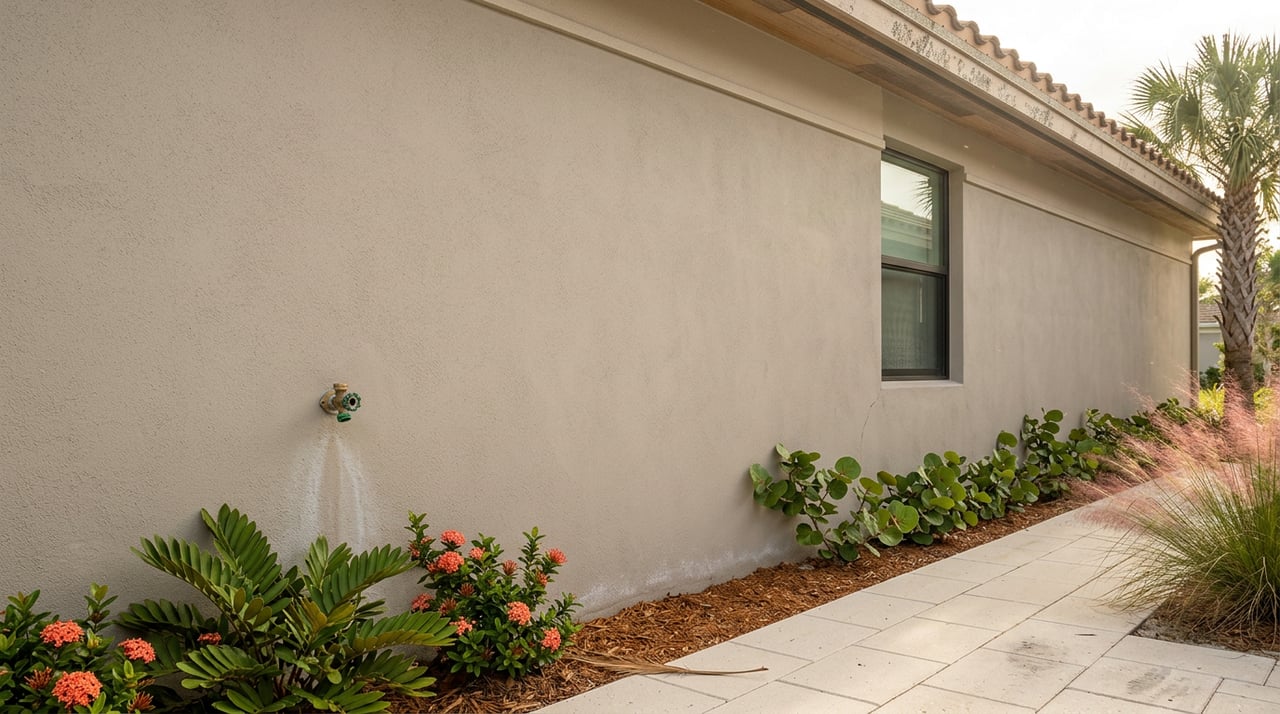
A buyer flew in from New Jersey last spring, walked a well-kept ranch in the F Section, and asked what the beige control panel on the exterior wall was for. The listing agent said it was part of the sewer. That was accurate, and it was also the beginning of a conversation that would change the inspection scope, the utility budget, and one specific line in the seller's disclosure.
Palm Coast has a sewer system that most Florida buyers have never encountered. Roughly half of the city's residential lots are connected to it. The price on the portal does not tell you which half. That is the friction this post is about.
PEP, briefly. Pretreatment Effluent Pumping. Wastewater from the house drains into a buried tank in the yard, a small pump moves it out to a city main, and a control panel on the side of the house watches the whole thing. The City of Palm Coast owns and operates the tank and pump. The homeowner still owns the plumbing on the house side of the tank, the electrical circuit feeding the panel, and the yard the tank sits in.
The section-number test
Before you write an offer on a Palm Coast home, look up the section. PEP systems serve specific ITT-platted sections of the city. According to the city's builder welcome packet, PEP tanks are located in sections 23, 26, 28, 29, 30, 31, 33, 34, 35, 37, 59, 60, 63, 64, and 65. Homes outside those sections are typically on conventional gravity sewer.
That distinction matters because the two systems fail differently, get inspected differently, and cost the homeowner differently when something goes wrong. The city maintains roughly 14,000 PEP tanks alongside 700 miles of gravity lines and 165 pump stations, and utility technicians field 30 to 50 PEP-related service calls a day. That volume is a clue. A PEP home is not a defective home. It is a home with a different maintenance interface, and that interface belongs to a public utility rather than to the property.
What the standard four-point misses
A Florida four-point inspection covers roof, electrical, plumbing, and HVAC. On a PEP-served home, the parts that fail first sit in the seam between what the homeowner owns and what the city owns. The seam is where surprises live.
Three items are worth walking to before the inspection and, more importantly, calling out to the inspector:
- The control panel. Green light should be on. A steady red light or a silenced alarm is a question, not necessarily a failure. Per the city's utility FAQ, an alarm during heavy rain is expected as stormwater infiltrates the tank, and the pump catches up over hours. An alarm on a dry day is different.
- The circuit that feeds the panel. The city maintains the pump inside the tank. The breaker and wiring at the house are the homeowner's. A tripped breaker looks like a city problem and behaves like an electrician's bill.
- The yard around the tank. Recent sod work, a settling depression, or a driveway extension over the tank lid can each become a real cost. The tank needs to be accessible for city crews.
None of these findings will show up on a boilerplate four-point summary. They surface only if the buyer or their agent asks for them by name.
PEP vs. gravity vs. septic, translated into transaction terms
Buyers relocating from other Florida markets often assume all three systems behave similarly at closing. They do not.
| System | Who owns the tank/pump | Who pays when it fails | Typical friction at inspection |
|---|---|---|---|
| PEP (Palm Coast) | City of Palm Coast | City for tank and pump; owner for panel wiring, house lateral, yard access | Alarm history, panel condition, yard grade over tank |
| Gravity sewer (parts of Palm Coast, most of Flagler Beach) | City | City for the main; owner for the lateral | Root intrusion in older laterals, cleanout location |
| Septic (rural Flagler, some acreage) | Homeowner | Homeowner for tank, drainfield, pump | Drainfield age, pump-out records, setback from wells |
The middle column is the one buyers reread. In a PEP home, the most expensive underground component in the yard is not the homeowner's to replace. That is a genuine advantage on cost, and it is also why the panel and the yard access clauses matter more than a septic buyer would expect.
The rate schedule that changes the carrying-cost math
There is a second variable that portals do not surface. Under the 2025 Utility Strategic Plan, Palm Coast raised utility rates by 8% in April 2025, another 8% in October 2025, and then shifted to annual CPI-based adjustments beginning October 2026. Those increases apply across water, sewer, and stormwater, and they exist because the state issued a 2024 consent decree requiring the city to expand sewer capacity by 2028.
The mechanics of that decree are worth understanding on your own dime, not your seller's. Wastewater Treatment Plant 1, the original plant built in the late 1970s by ITT Corporation at 26 Utility Drive, is permitted for 6.83 million gallons per day and has, per the strategic plan, roughly 300,000 gallons per day of capacity remaining. Wastewater Treatment Plant 2 on Peavey Grade is expanding from 2 to 4 million gallons per day. FlaglerLive has reported the second plant's expansion alone is projected to cost around $245 million by completion.
For a buyer running a payment sheet, the practical takeaway is that the utility line on the monthly budget is on a known upward path through 2028, and no amount of shopping insurance will offset it. Build the rate schedule into affordability, not the property tour.
Reading the market with these variables in mind
The June 2026 Palm Coast median sale price sat near $359,000. Data compiled from local MLS sources shows median days on market in the low triple digits through the first half of the year, with sale-to-list ratios in the mid-90s. Half of Palm Coast listings are sitting longer than that median before going under contract. That is not a distressed market. It is a market that rewards buyers who ask specific questions and sellers who answer them without theater.
In practice, that means a well-priced PEP-served home with a clean alarm history and clear yard access is at a small quiet advantage. A home with a red-light history the seller cannot document is at a small quiet disadvantage, and the disadvantage widens the longer the listing sits.
For sellers on a PEP lot
Two moves protect the transaction:
- Document the panel. A short letter or a screenshot from Palm Coast Connect showing no recent service cases will neutralize the buyer's most common concern before the inspection scope is set.
- Clear the tank access. If landscaping, a shed, a paver extension, or a fence has migrated over the tank lid since the last city visit, address it before showings begin. City crews need to reach the tank. A buyer's inspector will note the obstruction, and it will read like a bigger problem than it usually is.
On the disclosure form, the presence of a PEP system and any alarm events in recent memory belong in the sewer section. Florida disclosure is a "known material defects" standard, so a functioning PEP tank is not, by itself, a defect. A pattern of alarms that a seller has been living with, and has not reported, is a different question, and it is the one a buyer's attorney will ask.
FAQ
Does a PEP tank affect financing or insurance? Not directly. Conventional, FHA, VA, and USDA loans all fund PEP-served homes. Wind and general property policies do not price the sewer connection. The utility bill is where the effect shows up.
Can a buyer request the city's service history for the tank? The homeowner can pull records through Palm Coast Connect or by contacting Customer Service at 386-986-2360. A cooperative seller can share what they receive. There is no MLS field for it.
What happens during a hurricane or power outage? Per the city's guidance, the tank has roughly a day of reserve capacity at normal household use. Water conservation matters until power returns. Portable generators can support the panel circuit, and that is worth discussing with an electrician rather than improvising during a storm.
Is a home on a PEP tank worth less than one on gravity sewer? There is no consistent price difference in Palm Coast data. Buyer preference varies. The transactional variables above matter more than the label.
If you are weighing a Palm Coast home and want a specific read on the section, the sewer connection, and what the inspection should actually cover, Ramona Damian is glad to walk the property with you and put the questions in the right order before the offer goes in. Let's connect.